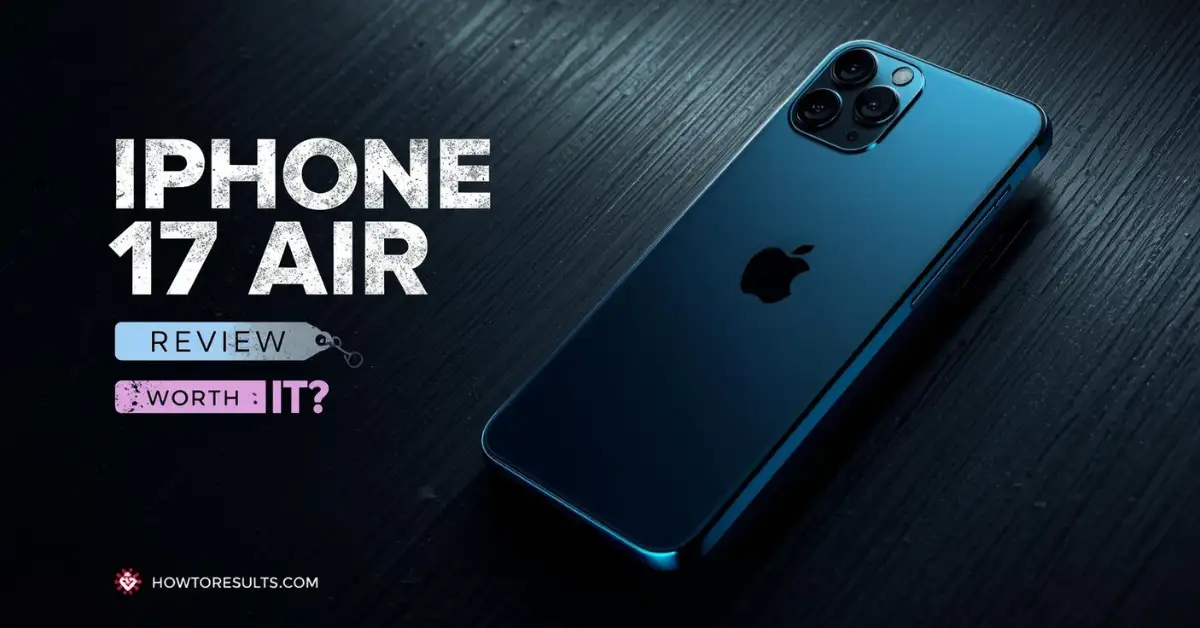
Last week, Apple didn’t just announce a new iPhone lineup; it introduced a new philosophy. The iPhone 17 Air, a device that surprisingly stole the show, isn’t about adding more features—it’s about subtracting weight. After nearly a week of intensive, real-world testing, it’s clear that this isn’t just a new model. It’s Apple’s boldest vision for the mainstream smartphone in years, and a gamble that has almost entirely paid off.
This review goes beyond the spec sheet to tell you how this phone actually feels to live with, from its shocking lightness to the crucial compromises made to achieve it.
iPhone 17 Air Review: The Quick Verdict
| The Good | The Not-So-Good |
| A stunningly thin and light industrial design | Battery life is a full day, but nothing more |
| The 120Hz ProMotion display is buttery smooth | Still uses the Dynamic Island, not the Pro’s new screen |
| A18 Pro chip delivers flagship-level performance | Camera lacks the optical zoom of the Pro models |
| A premium, near-Pro experience for less money | The ultra-thin design raises durability concerns |
What Exactly is the iPhone 17 Air?
The iPhone 17 Air is a new category. It’s for the person who wants more than the standard iPhone 17 offers—specifically a high-refresh-rate display—but doesn’t want to pay the premium for the iPhone 17 Pro’s advanced camera system.
- vs. iPhone 17: The Air is significantly thinner and lighter, has a much smoother 120Hz ProMotion display, and uses last year’s more powerful A18 Pro chip.
- vs. iPhone 17 Pro: The Air is thinner and lighter, but it lacks the Pro’s “Infinity Screen” (it still has a Dynamic Island), doesn’t have the new 10x periscope zoom camera, and uses the previous-generation A18 Pro chip instead of the new A19 Bionic.
Design: Impossibly Thin and Light
The first time you pick up the iPhone 17 Air, it feels almost unreal. At just 6.1mm thick and weighing nearly 25% less than the iPhone 17 Pro, it is an engineering marvel. It rests in your hand and pocket so comfortably that you almost forget it’s there. This was achieved with a re-engineered aluminum unibody that uses a new honeycomb-like internal structure to provide rigidity without the weight. The matte aluminum finish feels fantastic and comes in a unique set of pastel-inspired “Air” colors like Glacial Blue and Sunset Gold.
Display: ProMotion Comes to the Mid-Tier
This is the Air’s killer feature. It brings Apple’s beautiful and fluid ProMotion technology
to a more accessible price point. The 120Hz refresh rate makes every scroll, swipe, and animation feel incredibly smooth and responsive—a huge step up from the standard iPhone 17’s display. The trade-off? To keep costs down and differentiate from the Pro, the Air does not have the new under-display camera. It retains the Dynamic Island, which feels a bit dated next to the Pro’s “Infinity Screen,” but the fluidity of ProMotion is, for many, a more important daily benefit.
iPhone 17 Air Performance Review: The A18 Pro Chip
In a clever move, Apple has equipped the iPhone 17 Air with the A18 Pro chip from last year’s iPhone 16 Pro. Don’t let the “older” chip fool you—this is a performance powerhouse. In daily use, it feels just as fast as the A19 Bionic in the Pro models. Apps launch instantly, and it handles graphics-intensive games with ease thanks to its powerful 6-core GPU. For 99% of users, the performance is more than enough and represents a significant step up from the base iPhone 17.
Camera Review: Smart and Capable, But Not Pro
The iPhone 17 Air features the same excellent dual-camera system as the standard iPhone 17: a 48MP Main and a 12MP Ultra Wide. The pictures it takes are fantastic—sharp, vibrant, and great in low light. The A18 Pro chip also enables some advanced processing, resulting in slightly better detail than the base model. However, this is not a camera for zoom enthusiasts. It lacks the 10x periscope telephoto lens of the Pro models, so any significant zooming will be purely digital and result in a loss of quality. For everyday photos and social media, it’s brilliant; for serious photography, the Pro is still the way to go.
The Battery Life Compromise
To achieve its radical thinness, something had to give, and that’s the battery. The iPhone 17 Air has a noticeably smaller battery than its thicker siblings. In our testing, it reliably lasted a full day of moderate use (from 8 AM to 10 PM) with about 15% left. However, on days with heavy use—lots of 5G, camera use, and gaming—it needed a top-up by the late afternoon. It’s not bad by any means, but it doesn’t have the “go all day and into the next” stamina of the iPhone 17 Pro Max.
iPhone 17 Air Specifications
| Feature | iPhone 17 Air |
| Display | 6.1-inch Super Retina XDR with ProMotion (120Hz) |
| Processor | A18 Pro Chip (from iPhone 16 Pro) |
| Rear Cameras | Dual-Camera: 48MP Main, 12MP Ultra Wide |
| Front Camera | 12MP TrueDepth Camera (in Dynamic Island) |
| Storage | 128GB, 256GB, 512GB |
| Key Features | Ultra-thin and light design, Action Button, 5G |
| Price | Starting from $949 |
Frequently Asked Questions (FAQs)
Is the iPhone 17 Air waterproof?
Yes, it has the same IP68 water resistance rating as the other iPhone 17 models, meaning it can survive in up to 6 meters of water for 30 minutes.
Does the iPhone 17 Air have the Action Button?
Yes, the customizable Action Button is standard on all iPhone 17 models, including the Air.
Is the battery life bad on the iPhone 17 Air?
It’s not bad, but it is a compromise. It will last a full day for most users, but heavy users might need to charge it before the end of the day.
Should I get the iPhone 17 Air or the 17 Pro?
If you value a thin and light design and a smooth screen above all else, get the Air. If you need the best possible camera zoom and the longest battery life, get the Pro.
Does the iPhone 17 Air come in a bigger “Max” size?
No. For 2025, the Air is only available in a single 6.1-inch size to emphasize its focus on portability.
Final Verdict: Who Should Buy the iPhone 17 Air?
The iPhone 17 Air is a triumph of focused design. Apple took a risk by prioritizing weightlessness over battery longevity, and for the vast majority of users, it will be a welcome trade-off. It offers the two most impactful “Pro” features—a fluid display and flagship speed—in a design that feels futuristic and impossibly comfortable to use.
While power users and photography enthusiasts should still look to the iPhone 17 Pro for its advanced camera and AI features, the iPhone 17 Air is a near-perfect balance of premium features and forward-thinking design. It’s not just an alternative; it is, for the first time in a long time, the new default iPhone for most people.
To see how this model compares to the base model, you can read our full iPhone 17 review. For more in-depth tech guides, visit howtoresults.com.
